⊙ Jantar Mantar
In Jaipur, the capital of the Federal State of Rajasthan in the north-west of India, you will find one of the most timeless and culturally independent pieces of architecture in the world. A place where religion and science are still living in a non-secularized integrity, only comparable with the witnesses in stone of the archaic cultures.
The Jantar-Mantar (Sanskrit; translated as "Magical Device") was built between 1728 and 1734 based on the drafts of Maharaja Jai Singh II (1693 -1743) in the very centre of Jaipur, which he founded 1727 as new capital city of his principality. The true meaning and purpose of the observatory mostly lies in darkness as does the biography of Jai Singh II. There are only a few hints and many legends and interpretations.
The following description relies upon the rare material available at Jaipur during my visit in 1993, information and tales I got at the observatory and personal observations. It is my individual approach and interpretation based on many years of examination of Hinduism and ancient cultures.

Materialization of an Idea
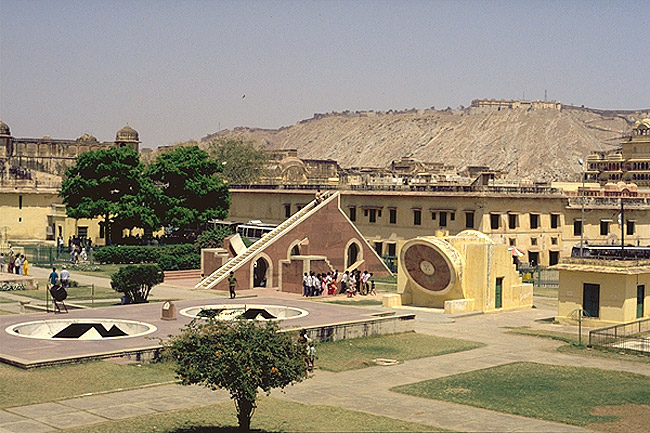
Jai Singh has designed Jaipur strictly corresponding to the architectural rules of the Shilpa Shastra, an ancient idealistic Hindu doctrine. The city is divided into seven rectangular areas reflecting the castes and their individual assignation. In the 7th central area lies the Palace, which houses the women's chambers and the holiest sanctum. Differing from the Shilpa Shastra rules, in this holy area Jai Singh had not built a temple, but the Jantar Mantar. Jaipur and the Jantar Mantar are in spite of Jai Singh's scientific and political cosmopolitanism of religious origin which is often ignored.
View from the big sundial to the small sundial.
In the background on the hill part of the fortress wall around Jaipur.
Islamic Tradition
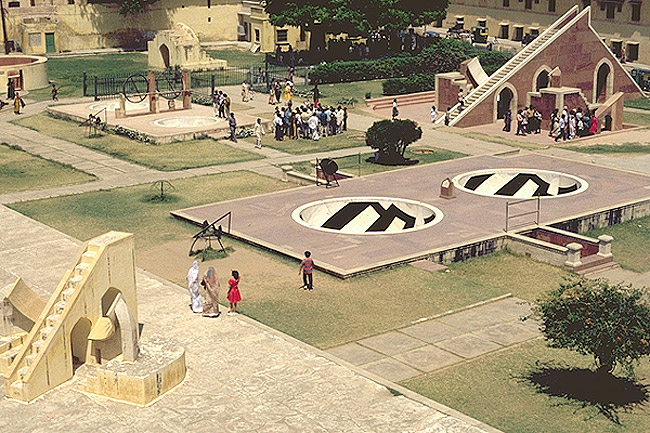
The observatory consists of oversized stone observation devices, which provide impressive accuracy due to their enormous dimensions. It is the biggest of five observatories, which Jai Sing II had built. The majority of the devices is typical for big observatories in the Islamic world. The most significant one, built by famous Ulugh Begh (1394-1449) in Samarkand has been an inspiring example for Jai Singh. But his instruments are unique as concerns precision, size and architectural perfection. At least, even 120 years after the invention of the telescope they still provided amazingly and sometimes unmatched results.
Bottom left one of the twelve zodiac gnomes, in the middle
the hemispheres of the Jai Praksh Yantra, top right the little sundial.
Jai Praksh Yantra
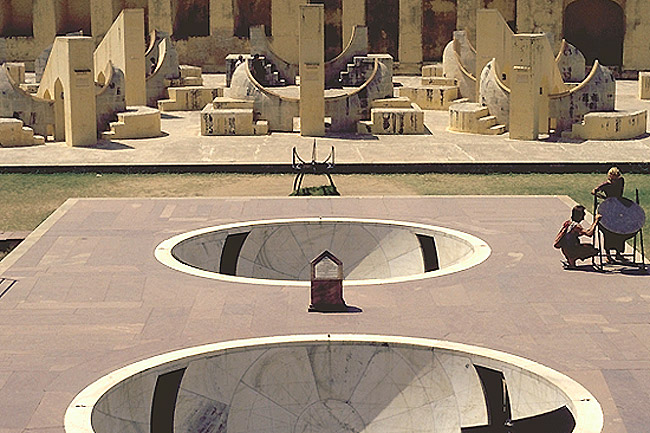
Several devices however, first and foremost the hemispheres of Jai Praksh Yantra which are set in the ground, are attributed to Jai Singh as new constructions. Two walkable complementary marble hemispheres set in the ground about 4 meters in diameter - a master piece by itself - where above a cross with a metal ring is applied. The inside surface is covered with coordinate lines. During the day the shadow of the metal ring allows to read the exact position of the sun on the coordinate lines, and of course the time. During the night a simple tube was used as a sighting device for observation.
The complementary hemispheres of Jai Praksh Yantra.
Behind of it some of the 12 zodiac gnomes used for measuring celestial coordinates.
Counterparts
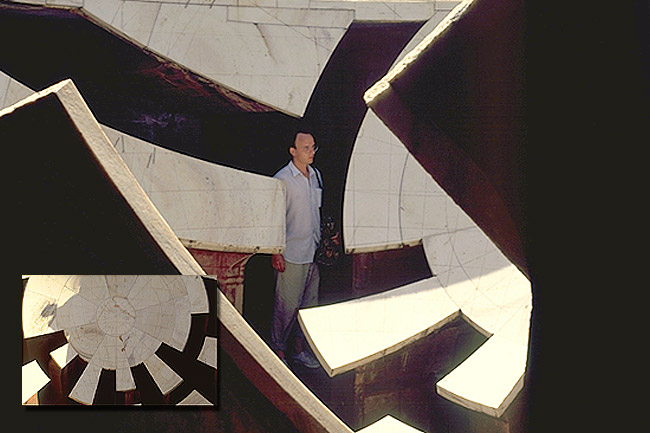
The observer lays down in the hemisphere and focuses on the stars through a sighting tube, whose end is held by the metal ring. The elongation of the tube onto the sphere's inside surface shows a star's position by reading the coordinate lines. To simplify measurement the Jai Praksh Yantra is made of two hemispheres, themselves complementary. In place of the passages in one hemisphere there are marble scales of the other and vice versa. Alternating use of the hemispheres within a two hours change allows observation around the clock.
One can walk on the inside of the hemispheres.
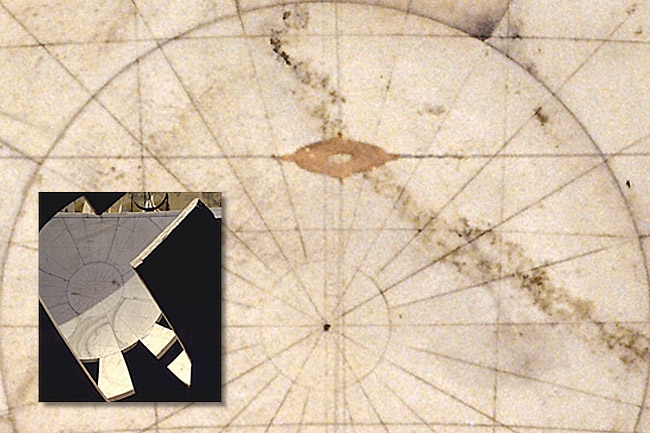
In the bottom left-hand corner the center of the scale that is half visible in the big picture.
An Observatory by itself
The scale's center is located 27 degrees below the edge. The connecting line between the scale's center and the metal ring points exactly to the Celestial North Pole. Proceeding from that point equatorial coordinates of the
celestial bodies can be read. The circle around the center shows the position of the Ecliptic Pole throughout the year. It helps determining celestial coordinates, too. All those observations of the sky are feasible just with the Jai Praksh Jantra. Maybe it is Jai Sing's major work, particularly because it lies in the center of Jantar Mantar and there is a smaller predecessor west of it.
In the bottom third the center of the scale and above the metal ring that holds the tube.
On the left the inside surface of the hemisphere.
Astronomic Basics
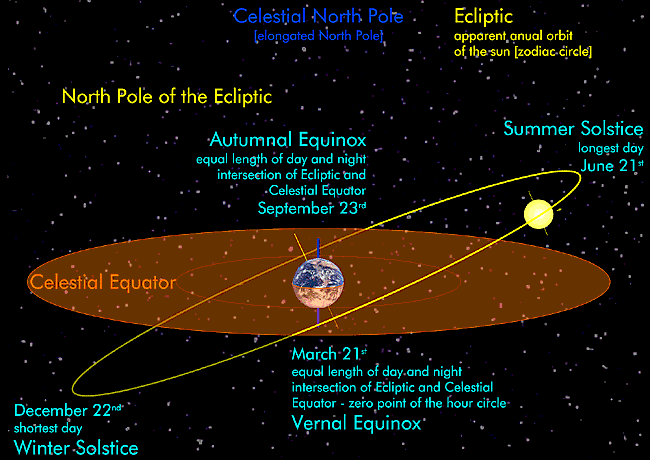
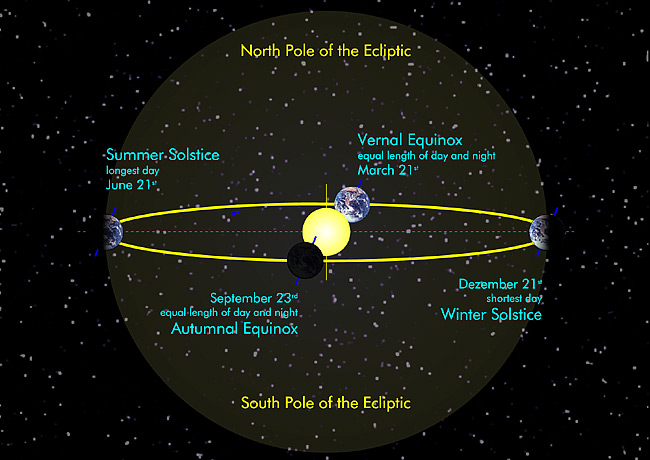
The apparent orbit of the sun around the earth - that is in fact the orbit of the earth around the sun - is called ecliptic. It is divided into 12 equal parts named the zodiac circle. The angle of 23 degrees between the ecliptic and the equator brings about the seasons as the varying length of day and night. On June 21 the summer solstice is in the northern hemisphere and with it the longest day. In the southern hemisphere it is winter solstice on June 21 with the shortest day. The sun stands vertically above 23 degrees northern latitude (Tropic of the Cancer). On March 21 the sun stands vertically above the equator, so day and night is identical.
Equinoxes
Ever since equinoxes are of exceptional importance for astronomers. These are the only days under identical circumstances all over the world. Day and night are exactly of the same length. The sun rises strictly in the east and sunset is strictly in the west. During equinoxes both poles of the earth lie over the ecliptic so both northern and southern hemispheres of the earth are lighted equally. In the course of the year the northern and southern hemispheres are lighted unequally. Beyond the polar circle the day and night side is permanently lighted for six months on each hemisphere (polar day).
Vernal Equinox
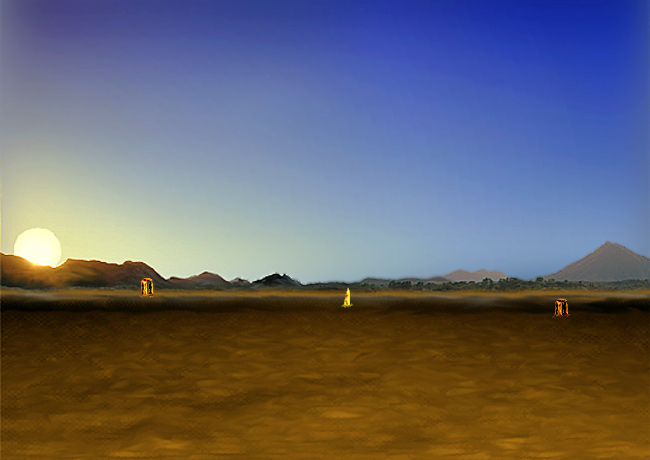
From the earliest times until today the vernal equinox was a reference point for position data. It can be determined in a relatively easy way at any place due to the point of sunrise on the eastern horizon and the point of sunset on the western horizon define a line straight through the observer's position on that day. Prehistoric observatories (e.g. Stonehenge) are orientated towards the vernal equinox. Depending on the world picture the vernal equinox defines a point on the horizon, on the sun's orbit or on the earth's orbit. The peculiarities of the coordinate systems are caused by these differences in the point of view.
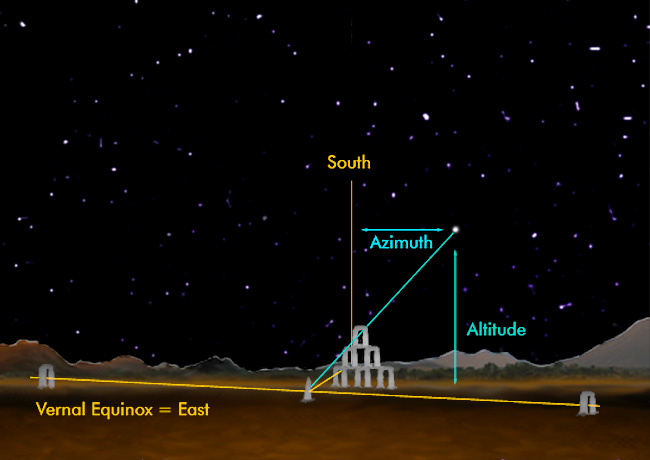
Horizont System
The easiest way to define a star's celestial position is in relation to the horizon line and the point of vernal equinox. Due to the rotation of the earth these position data are valid only for a certain observer's location, time and date. Observation of periodically recurring events in the sky (the sun's orbit, lunar phases, Venus' rise and set as morning and evening star, comets) allows to determine the seasons up to developing a precise calendar, but results are fixed to a certain location. With every change of location new observation is necessary. This is why the horizon system cannot be used for navigation purposes.
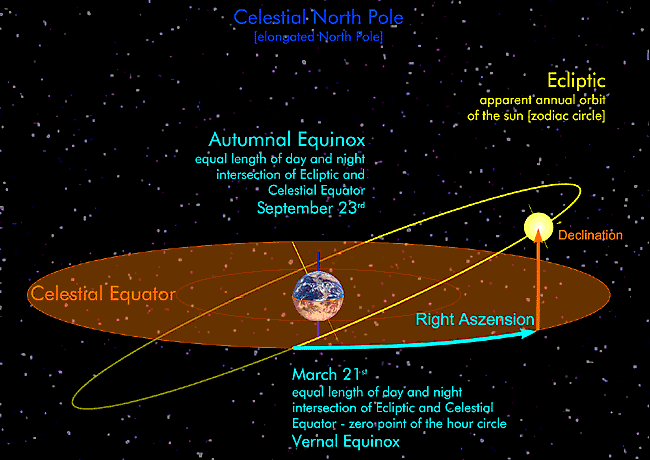
Equator System
A point of reference that is independent from the observer's location is offered with the Celestial Pole. All stars seem to rotate around it due to the earth's rotation. As the earth's axis is in circular motion itself, the Celestial Pole rotates around the Ecliptic Pole once in about 28850 years. In the equator system the celestial equator that is standing rectangular to the celestial pole is used as second point of reference. A star's position is defined by its height over the equator and angle to the vernal equinox. Since the vernal equinox is defined as a point on the celestial equator, it moves on the ecliptic as the celestial pole rotates.
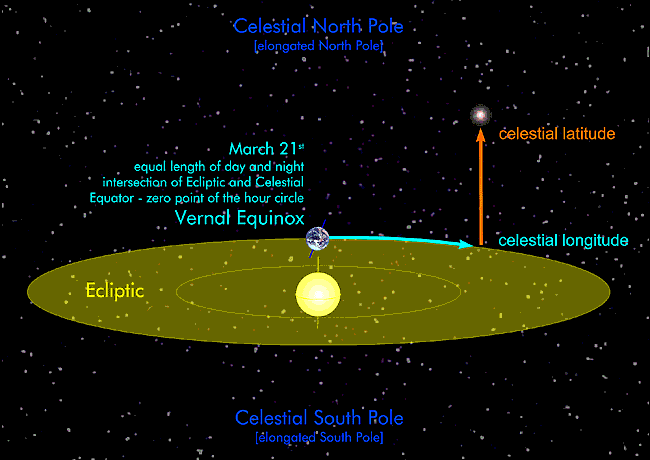
Ecliptic System
The apparent movement of the vernal equinox on the ecliptic is caused by the geocentric point of view the equator system is based on. The rotation of the celestial pole around the ecliptic pole as seen from the earth leads to a slow rotation of the zodiac signs around the zodiac circle. This is known since the antiquity (Platonic Year, 25850 years). As seen from the sun, the vernal equinox is a point on the orbit of the earth. The ecliptic system defines the position of a star in relation to the vernal equinox and the ecliptic. Within the solar system these position data are practically absolute, but most difficult to measure.
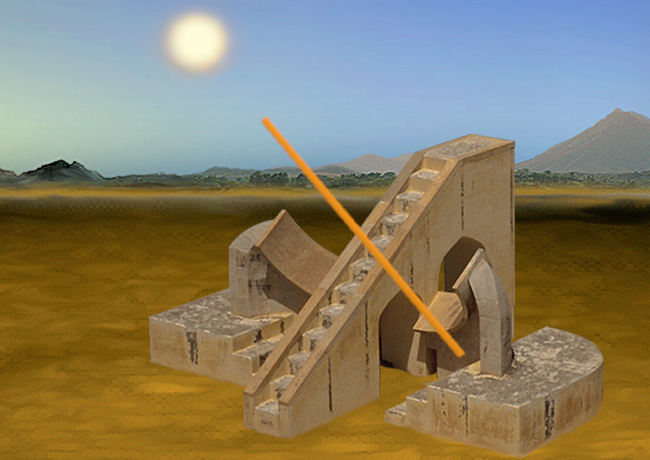
Shadow Pointer
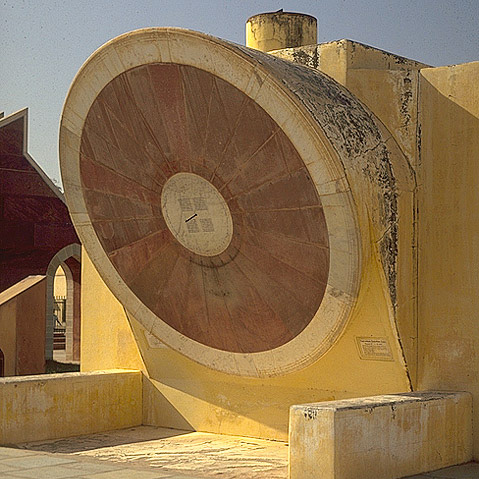
Gnomes, shadow indicators, are actually sundials. There are differences between the 14 gnomes of the Jantar Mantar in their function, but not in principle. With a sighting stick that rests against the quadrant and the ramp a celestial body is aimed at. At the bearing points of the sighting stick position data can be read from engraved markings. Depending on the orientation of the ramp to a point over the horizon, to the Celestial Pole or the Ecliptic Pole one can read position data corresponding to the horizon, equator or ecliptic system. Additionally time can be read from the ramp's shadow.
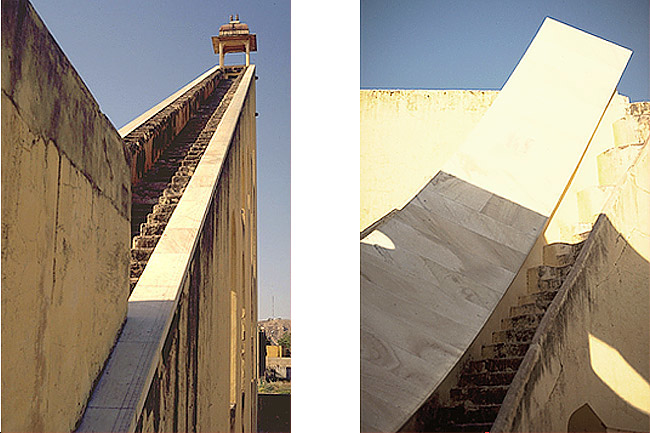
Samyat Yantra
Over 30 meters in height, the big sundial is the most impressive and the biggest device. The ramp that forms the indicator is orientated to the north. It's gradient of 27 degrees is equivalent to the latitude of Jaipur. Thus the ramp points exactly to the Celestial North Pole. The shadow of the indicator falls of the wing-shaped western and eastern scales. They are made of marble as the side edges of the indicator are, and covered with delicate measuring divisions. According to the size and architectural precision, the shadow shows the local time accurate within four minutes. Using a pointing stick accuracy reaches a few seconds.
On the left the ramp over 30 meters in height.
On the right the end of the eastern scale in the late afternoon.
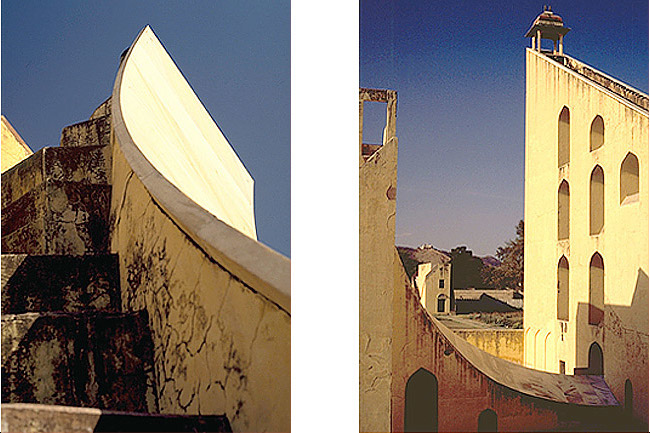
More than just History
With the help of a little shadow stick that is moved along the stairs until the shadow just touches the edge of the quadrant, the distance in degrees of the sun from the equator can be measured. This method allows the precise prediction of equinoxes and solstices which are of central meaning for all religious astronomical and astrological world systems. By the way, the ramp is sealed off from visitors. Until today only priests and the Maharaja may enter. The little sundial however is open to the public. It might always have been intended for everyday purpose.
On the left the end of the western scale. On the right the west side of the big sundial.
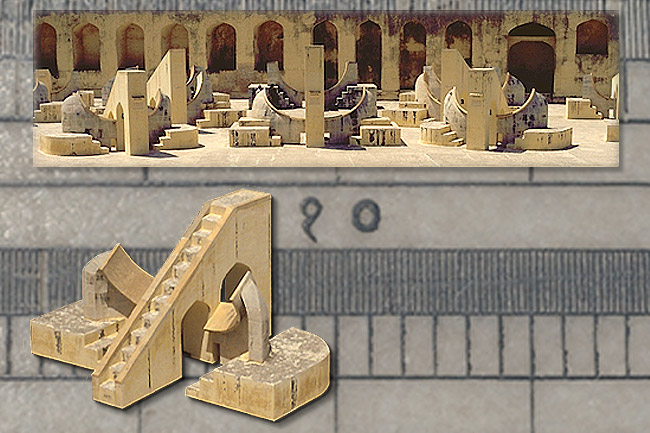
Zodiac Gnomes
Westward from Samyat Yantra there are 12 smaller gnomes about 2-3 meters high that are pointing at different directions. They are used to determining ecliptic coordinates. Their ramps are not orientated to the Celestial Pole but to the Ecliptic Pole. The quadrants lie in the plane of the ecliptic. Because the Ecliptic Pole appears to rotate around the Celestial Pole the ramp can only be oriented to the Ecliptic Pole for one fixed date. Each of the 12 gnomes points towards the position of the Ecliptic Pole at the beginning of a zodiac sign. With these 12 points of measurement interpolation for any other day is possible.
In front some of the 12 gnomes orientated to the zodiac.
In the background a detailed view of the sundial's scale made of lead inlays in marble.
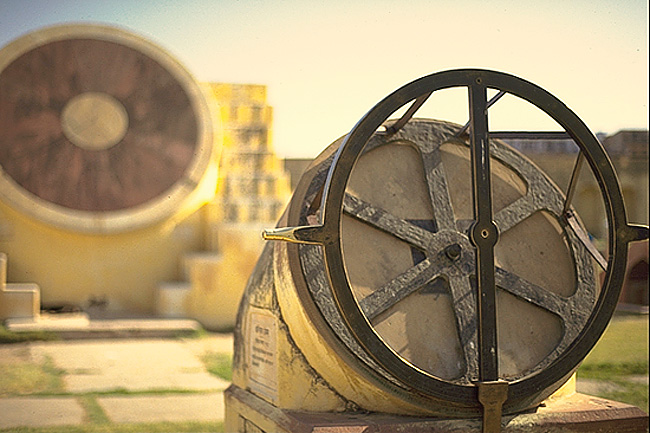
By far not all
Among many further devices, the big astrolabe should be particularly mentioned. It is a star chart engraved in a metal disc. Moveable rulers allow similar to a slide rule the calculation of rising and setting points as to convert coordinates and work out horoscopes. With a sighting tube the zenith distance of a star can be determined as well. Standard astrolabes are between 30 and 50 cm in diameter whilst the astrolabe of Jai Singh is around two meters in diameter. Jai Singh specially developed an alloy made of seven metals that prevents alternations in size due to warming up by the sun.
At the front the ecliptic device.
In the background the northern side of the equatorial double sundial.
More about it
At the time of first publishing not much has been written about this uniquely integrating work of art, science and religion, though it is used to be mentioned in special literature as extraordinary. Maybe there was no real interest in pointing out Jantar Mantar's relevance as after all the claim to scientific omnipotence of the enlighted modern times is seriously relativized by Jai Singh's religious-scientific intention. Most of the devices of the Jantar Mantar are limited to the means of a highly developed Stone Age culture. They might as well have stood in Egypt, in South America or in Stonehenge.
Addendum: In 2001 "Cosmic Architecture in India" by Andreas Volwahsen (Prestel Verlag) was published. While it emphasizes the technical-scientific aspect of Jantar Mantar over the still living magical-mystical cultural meaning the book is highly recommended to anyone interested.
The southern side of the equatorial double sundial.
First published 1998, revised 2013, new layout and minor changes 2023